二叉树旋转重构定理
核心定理
O ( n ) O(n) O ( n )
定理证明
证明思路:双向构造法
步骤1:任意树 → 规范右链(Canonical Chain)
1
2
3
4
5
6
7
8
9
10
def to_canonical_chain (tree ): """将任意二叉树转换为右链结构""" rotations = 0 while tree 不是右链: node = find_last_rotatable_node(tree) if node 存在左子树: tree = right_rotate(node) rotations += 1 return tree, rotations
关键观察 :
每次右旋转使中序遍历最后一个节点 的深度增加 1
最终链中最后一个节点深度 = n − 1 n - 1 n − 1
因此最多需要 n − 1 n - 1 n − 1
步骤2:规范右链 → 目标树
1
2
3
4
5
6
7
8
9
10
11
12
13
def chain_to_target (chain, target_tree ): """从规范链反向旋转到目标树""" rotations = 0 current = chain while current 的结构 != target_tree: if 需要左旋转: current = left_rotate(current) else : current = right_rotate(current) rotations += 1 return current, rotations
旋转操作详解
基本旋转类型
右旋转(Right Rotation)
1
2
3
4
5
6
7
8
9
10
11
12
13
初始状态: y / \ x C / \ A B 右旋转后: x / \ A y / \ B C
数学性质 :保持中序遍历顺序 A → x → B → y → C 不变
左旋转(Left Rotation)
1
2
3
4
5
6
7
8
9
10
11
12
13
初始状态: x / \ A y / \ B C 左旋转后: y / \ x C / \ A B
旋转操作的性质
性质
说明
保持遍历顺序 旋转前后中序遍历结果相同
局部操作 只影响旋转节点及其直接子树
时间复杂度 每次旋转 O ( 1 ) O(1) O ( 1 )
可逆性 左旋转与右旋转互为逆操作
复杂度分析
旋转次数上界
阶段
最大旋转次数
说明
任意树 → 规范链
≤ n − 1 \leq n-1 ≤ n − 1 每个节点最多被"提升"一次
规范链 → 目标树
≤ n − 1 \leq n-1 ≤ n − 1 反向操作对称
总计 ≤ 2 ( n − 1 ) \leq 2(n-1) ≤ 2 ( n − 1 ) O ( n ) O(n) O ( n )
数学推导
设树有 n n n
规范链中最后一个节点的深度:n − 1 n-1 n − 1
从任意树到规范链:最多需要 n − 1 n-1 n − 1
反向操作同理:最多 n − 1 n-1 n − 1
总旋转次数 :≤ 2 ( n − 1 ) = O ( n ) \leq 2(n-1) = O(n) ≤ 2 ( n − 1 ) = O ( n )
具体示例演示
示例:重构二叉树
初始树 (中序遍历:A, B, C, D, E)
目标树 (相同中序遍历)
重构步骤
阶段1:转换为规范链
1 2 3 4 5 6 7 8 9 10 11 12 13 14 15 16 17 步骤1: 在C处右旋转 B / \ A C \ E / D 步骤2: 在E处右旋转 B / \ A C \ D \ E
阶段2:从链到目标树
1 2 3 4 5 6 步骤3: 在D处左旋转 B / \ A D / \ C E
总旋转次数 :3次(< 2 ( 5 − 1 ) = 8 < 2(5-1) = 8 < 2 ( 5 − 1 ) = 8
AVL 树:高度平衡
AVL 树的基本性质
AVL 属性(高度平衡属性)
一个节点是高度平衡的 ,如果它的左子树和右子树的高度差最多为 1。
偏斜度(Skew)定义
节点的偏斜度 = 右子树高度 - 左子树高度
平衡条件 :偏斜度 ∈ {-1, 0, 1}
1 2 3 4 5 6 7 8 9 10 def is_avl_balanced (node ): """检查节点是否满足 AVL 平衡条件""" if node is None : return True left_height = get_height(node.left) right_height = get_height(node.right) skew = right_height - left_height return abs (skew) <= 1
高度平衡的理论保证
核心定理
具有高度平衡节点的二叉树的高度 h = O ( log n ) h = O(\log n) h = O ( log n )
等价表述:n = 2 Ω ( h ) n = 2^{\Omega(h)} n = 2 Ω ( h )
证明思路:最小节点数分析
定义 F ( h ) F(h) F ( h ) h h h
边界条件
F ( 0 ) = 1 (只有根节点) F(0) = 1\quad \text{(只有根节点)} F ( 0 ) = 1 ( 只有根节点 ) F ( 1 ) = 2 (根节点 + 1个子节点) F(1) = 2 \quad \text{(根节点 + 1个子节点)} F ( 1 ) = 2 ( 根节点 + 1 个子节点 )
递归关系
由于要求平衡,高度为 h h h
1 个根节点
1 个高度为 h − 1 h-1 h − 1
1 个高度至少为 h − 2 h-2 h − 2
因此:
F ( h ) = 1 + F ( h − 1 ) + F ( h − 2 ) F(h) = 1 + F(h-1) + F(h-2) F ( h ) = 1 + F ( h − 1 ) + F ( h − 2 )
下界推导
F ( h ) = 1 + F ( h − 1 ) + F ( h − 2 ) ≥ F ( h − 1 ) + F ( h − 2 ) ≥ 2 F ( h − 2 ) F(h) = 1 + F(h-1) + F(h-2) \geq F(h-1) + F(h-2) \geq 2F(h-2) F ( h ) = 1 + F ( h − 1 ) + F ( h − 2 ) ≥ F ( h − 1 ) + F ( h − 2 ) ≥ 2 F ( h − 2 )
递推得到:F ( h ) ≥ 2 F ( h − 2 ) ≥ 2 2 F ( h − 4 ) ≥ ⋯ ≥ 2 h / 2 F ( 0 ) = 2 h / 2 F(h) \geq 2F(h-2) \geq 2^2F(h-4) \geq \cdots \geq 2^{h/2}F(0) = 2^{h/2} F ( h ) ≥ 2 F ( h − 2 ) ≥ 2 2 F ( h − 4 ) ≥ ⋯ ≥ 2 h /2 F ( 0 ) = 2 h /2
因此:n ≥ F ( h ) ≥ 2 h / 2 ⟹ h ≤ 2 log 2 n = O ( log n ) n \geq F(h) \geq 2^{h/2} \implies h \leq 2\log_2 n = O(\log n) n ≥ F ( h ) ≥ 2 h /2 ⟹ h ≤ 2 log 2 n = O ( log n )
AVL 树的动态维护
插入/删除后的影响
当在高度平衡树中添加或删除叶子节点时:
影响范围 :只有该叶子节点的祖先节点的子树高度会改变高度变化 :每个受影响节点的高度变化最多为 ±1偏斜度变化 :偏斜度的幅度仍然 ≤ 2
重新平衡策略
自底向上修复
1 2 3 4 5 6 7 8 9 10 11 12 13 def avl_fixup (node ): """从叶子节点向上修复 AVL 平衡""" while node is not None : if not is_avl_balanced(node): node = rebalance(node) update_height(node) node = node.parent
重新平衡最低失衡祖先
算法策略 :从叶子节点开始向上,重新平衡第一个 遇到的不平衡祖先节点
不失一般性 :假设偏斜度为 2(右子树太重)
重新平衡操作分类
根据偏斜度情况的旋转策略
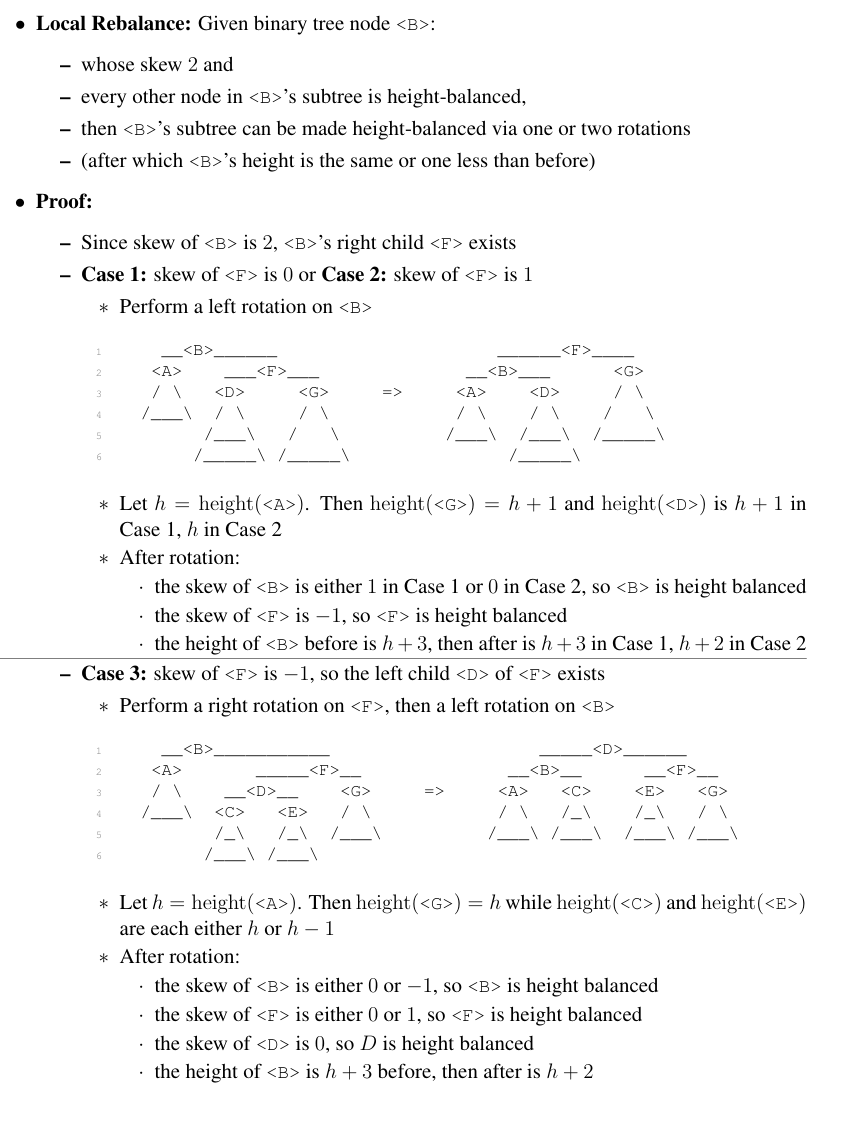
情况1:偏斜度 = 2(右子树太重)
1 2 3 4 5 6 7 8 9 10 11 def rebalance_right_heavy (node ): """重新平衡右子树太重的节点""" right_child = node.right right_skew = get_skew(right_child) if right_skew >= 0 : return left_rotate(node) else : node.right = right_rotate(right_child) return left_rotate(node)
情况2:偏斜度 = -2(左子树太重)
1 2 3 4 5 6 7 8 9 10 def rebalance_left_heavy (node ): """重新平衡左子树太重的节点""" left_child = node.left left_skew = get_skew(left_child) if left_skew <= 0 : return right_rotate(node) else : node.left = left_rotate(left_child) return right_rotate(node)
性能分析
时间复杂度保证
操作
时间复杂度
说明
查找 O ( log n ) O(\log n) O ( log n ) 树高度为 O ( log n ) O(\log n) O ( log n )
插入 O ( log n ) O(\log n) O ( log n ) 查找位置 + 向上重新平衡
删除 O ( log n ) O(\log n) O ( log n ) 查找位置 + 向上重新平衡
旋转操作 O ( 1 ) O(1) O ( 1 ) 每次操作只影响常数个节点
空间复杂度
存储开销 :每个节点需要存储高度信息(O ( 1 ) O(1) O ( 1 ) 递归栈 :O ( log n ) O(\log n) O ( log n )
实际示例
插入操作示例
这边给出原pdf中的部分
AVL 树全局重新平衡与高度计算
全局重新平衡定理
定理陈述
向高度平衡树 T T T T ′ T' T ′ O ( log n ) O(\log n) O ( log n ) T ′ T' T ′ T ′ ′ T'' T ′′
证明思路
影响范围分析
1 2 3 4 5 6 7 8 def affected_ancestors (leaf ): """只有叶子节点的祖先节点会受到影响""" ancestors = [] current = leaf.parent while current is not None : ancestors.append(current) current = current.parent return ancestors
关键观察 :
只有受影响叶子节点的祖先节点 的子树高度可能改变
祖先节点数量:h = O ( log n ) h = O(\log n) h = O ( log n )
插入操作分析
1 2 3 4 5 6 7 8 def handle_insertion (imbalanced_node ): """处理插入导致的失衡""" if imbalanced_node.skew == 2 : if imbalanced_node.right.skew >= 0 : return left_rotate(imbalanced_node) else : return right_left_rotate(imbalanced_node)
插入特性 :
删除操作分析
1 2 3 4 5 6 7 def handle_deletion (imbalanced_node ): """处理删除导致的失衡""" current = imbalanced_node while current is not None and not is_balanced(current): current = rebalance(current) current = current.parent
删除特性 :
可能需要在整个祖先链 上重新平衡
但最多 O ( log n ) O(\log n) O ( log n )
高度计算优化策略
朴素方法的问题
1 2 3 4 5 6 7 def naive_height (node ): """朴素的高度计算方法 - Ω(n) 时间""" if node is None : return -1 left_height = naive_height(node.left) right_height = naive_height(node.right) return 1 + max (left_height, right_height)
问题 :每次都需要递归计算,时间复杂度 Ω ( n ) \Omega(n) Ω ( n )
解决方案:节点增强(Augmentation)
增强设计
1 2 3 4 5 6 7 class AVLNode : def __init__ (self, key ): self .key = key self .left = None self .right = None self .parent = None self .height = 0
常数时间高度计算
1 2 3 4 5 6 7 8 9 10 11 def get_height (node ): """O(1) 时间获取节点高度""" if node is None : return -1 return node.height def compute_height_from_children (node ): """根据子节点高度计算当前节点高度""" left_height = get_height(node.left) right_height = get_height(node.right) return 1 + max (left_height, right_height)
高度维护机制
旋转操作中的高度更新
1 2 3 4 5 6 7 8 9 10 11 def left_rotate (x ): """左旋转并更新高度""" y = x.right x.right = y.left y.left = x x.height = compute_height_from_children(x) y.height = compute_height_from_children(y) return y
关键点 :只有旋转直接涉及的节点 需要更新高度,祖先节点高度不变。
插入/删除操作的高度维护
1 2 3 4 5 6 7 8 9 10 11 12 def update_ancestor_heights (node ): """更新从节点到根路径上所有节点的高度""" current = node while current is not None : old_height = current.height new_height = compute_height_from_children(current) if old_height == new_height: break current.height = new_height current = current.parent
完整的AVL插入操作
1 2 3 4 5 6 7 8 9 10 11 12 13 14 15 16 17 18 19 def avl_insert (root, key ): """完整的AVL树插入操作""" new_node = bst_insert(root, key) update_ancestor_heights(new_node) current = new_node while current is not None : if not is_balanced(current): current = rebalance(current) update_ancestor_heights(current) current = current.parent return find_root(new_node)
时间复杂度分析
各操作的时间复杂度
操作
时间复杂度
说明
高度查询 O ( 1 ) O(1) O ( 1 ) 直接访问存储的高度
单次旋转 O ( 1 ) O(1) O ( 1 ) 更新常数个节点的高度
高度更新链 O ( log n ) O(\log n) O ( log n ) 最多更新 log n \log n log n
重新平衡 O ( log n ) O(\log n) O ( log n ) 最多处理 log n \log n log n
完整插入 O ( log n ) O(\log n) O ( log n ) 查找 + 更新 + 重新平衡
完整删除 O ( log n ) O(\log n) O ( log n ) 查找 + 更新 + 重新平衡
空间复杂度分析
每个节点 :O ( 1 ) O(1) O ( 1 ) 总空间 :O ( n ) O(n) O ( n )
实际实现考虑
高度维护的优化技巧
1 2 3 4 5 6 7 8 9 10 11 def smart_height_update (node ): """智能高度更新:只有必要时才更新""" while node is not None : old_height = node.height new_height = 1 + max (get_height(node.left), get_height(node.right)) if old_height == new_height: return node.height = new_height node = node.parent
批量操作优化
对于连续的插入/删除操作,可以考虑:
延迟重新平衡 :累积多个操作后一次性重新平衡批量高度更新 :优化更新路径的计算
总结
理论贡献
全局平衡保证 :O ( log n ) O(\log n) O ( log n ) 高效维护机制 :通过节点增强实现 O ( 1 ) O(1) O ( 1 ) 最优时间复杂度 :所有动态操作保持 O ( log n ) O(\log n) O ( log n )
实践意义
AVL树的这种设计模式展示了:
增强数据结构 的强大威力局部更新 避免全局重新计算理论界限 在实际中的可达成性
正是这种精妙的高度维护机制,使得AVL树能够在动态操作中高效维持严格平衡!